

Tamanna Negi
Centre for Hindu Studies,
University of Delhi
Email : tamannanegitamanna2002@gmail.com
Abstract
The concept of Ardhanārīśvara, the half-male and half-female form of Lord Shiva and Goddess Pārvatī, probably is one of the most greatest ideas ever to originate in Bhartiya philosophy; it represnts the universal balance between masculine and feminine powers. This paper will try to discover the Philosophical, textual, and symbolism factors of the concept Ardhanārīśvara and its relevance to the modern world.
The concept traces its origin back to early Hindu scriptures, specifically the Bṛhadāraṇyaka Upaniṣad, Shiva Purāṇa and Ardhanarishvara strotam by Adi Guru Shankaracharya where the concept of Brahm dividing itself into two separate energies (dualism) is clearly mentioned. It further explains how in the end, both energies are one only and cannot exist without the other. The project also shows how the concept was picturised and idolised over time. To conclude, the project once again confirms that the image of Ardhanārīśvara is both a divine and psychological fact; a reminder that completeness and harmony come only through the union of opposite, dual forces and how the balance of both energies is essential for the flow of life in the universe.
Keywords:
Ardhanārīshvara, Shiva–Shakti, Unity of opposites, Śiva Purāṇa, masculine and feminine forces, Gender Balance, Gender equality
Introduction
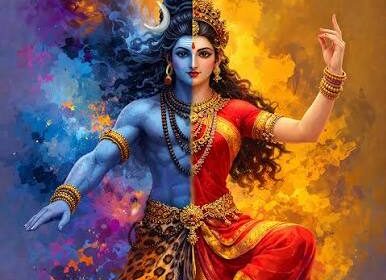
Ardhanārīśvara is one of the most interesting symbols in Bhartiya culture and spiritual beliefs, where Lord Shiva and Goddess Pārvatī are combined into a single divine body, representing the unification of masculine and feminine forces.
The 3 Sanskrit words “Ardha,” meaning half, and “Nārī,” meaning woman, combined with “isvara” to form “Ardhanārīśvara,” meaning the deity who is half woman, half God or the deity that has the qualities of both Man and Woman.
Throughout Hindu Philosophy and spiritual history, the text has been mentioned in various texts with different motives but the core always remained the same: The oneness of both the energies that create the universe and play an important role in its functioning and even its destruction.
The Ardhanārīśvara is a spiritual metaphor of wholeness and of balance between consciousness and energy, logic and emotion, masculine and feminine. The concept also portrays in with the contemporary debates on gender equality and self-integration, making it of eternal importance.
In this form lies the eternal truth that consciousness (Shiva) and energy (Shakti) are inseparable. Neither is able to prosper on its own. Shiva is lifeless without Shakti, while Shakti is aimless without Shiva. This picture of Ardhanārīśvara, therefore, teaches us the value of ‘balance’ in nature, society, and ourselves.
Research Questions:
- How can the concept of Ardhanarishvara relate with the modern gender biases and social conflicts?
- How and why did the Brahm divide into two?
- Context of the divine fusion of Shiva and Shakti with special reference to the Shiva Purana?
Hypothesis Statement:
The interdependence of the Divine Ardhanarishvara form explores the idea of how the two forces of the world: The Consciousness(masculine) and the Energy(feminine) are interdependent on each for the swift working of the Universe. The concept also reveals the importance of both the male and female energy in all aspects of the Universe and life and how we as a society should learn this view on life and enact this in our lives to get rid of any comparisons, conflicts and inequalities that are in the society regarding the both forms, which are in the end- One.
Literature Review:
Ardhanarishvara, that half-male, half-female figure of Shiva and Shakti, is usually thought of as a symbol of how masculine and feminine energies come together. Ancient writings describe this figure as a form of the male and female principles combined, representing completeness. Experts see this icon in many ways. Some think it is a symbol of gender equality, while others see it as a representation of the male and female sides within us all. Stories, especially in modern Hindi writings, use Ardhanarishvara to question gender roles in today’s world. This symbol is bringing together mythology, spirituality, psychology, and today’s social thinking.
Methodology:
The methodology used in this paper is textual analysis of Sanskrit scriptures in their original and translated form, secondary references from commentaries and scholarly works on Hindu theories, and comparative study with modern psychological theories and misunderstandings regarding the term. Besides, picture descriptions of the concept with special reference to the Ardhanarishvata strotam by Adi Guru Shankaracharya will be shown.
Origin Texts and Early References
In the Upaniṣads:
Shvetashvatara Upanishad: The time period of origin of Shvetashvatara Upanishad is uncertain, but it holds an important place within the development of Shaivism and the concept of Ardhanarishvara which develops more complex later on.
Its main argument is that of Rudra as the source of Purusha and Prakriti: The Upanishad presents the Vedic deity Rudra as the avatar of Shiva and the ultimate root of both Purusha: the male, conscious, passive energy, and Prakriti: the female, energetic, active energy.
Hint of Genderless-ness: While describing the ultimate reality as Rudra/Shiva containing male and female sides, the text gives a hint at the gender less nature of the Divine, thus “sowing the seed” for the later, fully developed Ardhanarishvara form.
This view agrees with the ultimate reality beyond even gender and duality, including within itself all the existing aspects of existence.
Verse 4.3 states, Brahm, the eternal one transcends all genders and structures. Hinting that all genders, energies and forces are from that one Brahm only.
त्वं स्त्री त्वं पुमानसि त्वं कुमार उत वा कुमारी।
त्वं जीर्णो दण्डेन वञ्चसि त्वं जातो भवसि विश्वतोमुखः॥
Translation: You are woman. You are man. You are the son and also the daughter. As an old man you walk with a stick. Being born you assume many faces in all directions.
Brihadāranyaka Upanishad:
The roots of the Ardhanārīśvara concept or the Eternal one (Brahm) splitting into two energies can be mostly traced in the
Bṛhadāraṇyaka Upaniṣad, Verse 1.4.3:
स वै नैव रेमे तस्मादेकाकी न रमते स द्वितीयमैच्छत्। स हैतावानास यथा स्त्रीपुमासौ सम्परिष्वक्तौ। स इममेवात्मानं द्वेधाऽपातयत्ततः पतिश्च पत्नी चाभवतां तस्मादिदमर्धबृगलमिव स्व इति ह स्माह याज्ञवल्क्यस्तस्मादयमाकाशः स्त्रिया पूर्यत एव ता समभवत्ततो मनुष्या अजायन्त॥
Translation: He was not at all happy. Therefore people (still) are not happy when alone. He desired a mate. He became as big as man and wife embracing each other. He parted this very body into two. From that came husband and wife. Therefore, said Yājñavalkya, this (body) is one-half of oneself, like one of the two hálves of a split pea. Therefore this space is indeed filled by the wife. He was united with her. From that men were born.
This is the earliest philosophical expression of Ardhanārīśvara; showing that male and female are not separate creations but two halves of the same Self (Ātman).
In the Purāṇas:
Śiva Purāna – Section 2.1 – Rudra-saṃhitā, Chapter 16:
Description of the creation: After creating the various sages from his body and mind, Brahma was faced by the challenge of creating further life in the universe. For this, he meditated and found the answers through the Ardhanarishvara form of Shiva and his consort Amba.
I created many other things as well, but O sage, I was not satisfied. Then O sage, I meditated on Śiva and his consort Ambā and created aspirants.
At another place, the Skand Purana mentions Parvati as asking Shiva, ‘Let me reside in you all the while embracing you limb by limb’, that is, Parvati merges into Shiva, limb to limb, and the duality is eliminated. The Shiva Purana puts it somewhat differently.
Śaṅkarācārya’s Ardhanārīśvara Stotram:
The Ardhanārīśvara Stotram, composed by Ādi Śaṅkarācārya (8th century CE), is one of the earliest devotional hymns that poetically expresses the inseparable unity of Lord Śiva and Goddess Pārvatī. It describes how the divine masculine and feminine coexist in perfect harmony as two halves of one truth.
झणत्क्वणत्कङ्कणनूपुरायै पादाब्जराजत्फणिनूपुराय ।
हेमाङ्गदायै भुजगाङ्गदाय नमः शिवायै च नमः शिवाय ॥३॥
Translation: I bow to the form In which the half of Goddess Parvati is adorned with the pleasant sound making ornaments worn on the wrists (Kankanas) and those of ankles (Nupuras) While in the other half, the lotus feet of God Shiva adorned with the serpents as the anklets The excellent form, where the half of Parvati is with the ornaments of Gold, while the other half (of Shiva) is adorned with serpents as ornaments I bow to you, Goddess Parvathi and God Shiva in the form of Ardhanareeswara
प्रपञ्चसृष्ट्युन्मुखलास्यकायै समस्तसंहारकताण्डवाय ।
जगज्जनन्यै जगदेकपित्रे नमः शिवायै च नमः शिवाय ॥ ७ ॥
Translation: She dances in delight with captivating beauty at face of creation which springs forth from them. His dance of destruction is in fury and the cosmos subsides back in them. She is the mother of this world and He is the Father. Such is the wonderful nature of ardhanarishvara and I bow to shri Shiva and Shiva.
Philosophical Interpretation of the Strotam:
This hymn was used by Śaṅkarācārya, who was well-known for his Advaita (non-dualism) philosophy, to convey oneness through dual appearance. The divine is one and the same, even though it takes the form of two entities, Śiva and Śakti. In this stotram, Adi guru Shankaracharya explores how the forms are different from each other in the physical manner but are one on the inside and are important as the holders and operators of the world. Therefore, Śaṅkarācārya claims that all differences- male and female, creator and creation, spirit and matter finally merge into one non-dual reality: Brahm. Further expressing the eternal truth that Shiva and Shakti are one in essence, two only in appearance.
Other works by Adi Guru Shankaracharya:
शिवः शक्त्या युक्तो यदि भवति शक्तः प्रभवितुं
न चेदेवं देवो न खलु कुशलः स्पन्दितुमपि ॥
This verse is the opening line of Saundaryalaharī composed by Adi Shankaracharya, which means that without Shakti (energy), even Shiva is like a corpse, unable to move.
Translation: Only when united with Shakti does Shiva become capable of creation; otherwise, even the Lord cannot stir.
Symbolism – Shiva and Shakti as Cosmic Principles
The form of Ardhanārīśvara depicts Shiva on the right and Shakti on the left. The two halves are further classified on physical and psychological levels. Some of these are discussed in the following points:
- Shiva (masculine): consciousness, stillness, awareness, logic, and detachment.
- Shakti (feminine): energy, creativity, emotion, and passion.
Both are two faces of one reality.
A popular Śaiva verse from the Advait-vaad philosophy expresses this perfectly:
यथोऽहं न लयं याति त्वं नापि प्रकटं यथा ।
तथैव त्वं च अहं चैव एकं रूपं द्विधा स्थितम् ॥
Meaning: As I (Shiva/Purusha) never dissolve without You (Shakti/Prakriti), and You never manifest without Me, so we are one form, appearing as two. This divine balance extends to human life and society. It promotes the message of masculine and feminine traits being present in every human and that we should accept these traits if we wish to truly understand who we are and how we should be.
In this way, Ardhanārīśvara is not merely a divine being but the true core of Hindu belief and thought that does not differ between the two creating forces of the Universe and even of human lives.
Present Relevance and Modern Interpretation
In the modern world which is divided by gender inequalities and differences in society based on gender, the philosophy of Ardhanārīśvara offers positive wisdom. It teaches that true essence of the world lies in equality and co-existence rather than one dominating the other energy. The answer for the modern social problems of patriarchy, misogyny, and crimes towards women lies deeply rooted in our Ancient Hindu knowledge. The harmony between the both energies is promoted and shown as the only way one to reach the True self- Brahm.
In contemporary terms, Ardhanārīśvara teaches us:
- to respect equality of the two genders
- to learn the balance between practicality and emotions
- and to realise that the divine is not based on any social restrictions we have created as a society.
Thus, Ardhanārīśvara is not merely a mythic figure, but a guide for inner integration and social harmony.
Misuse and Misinterpretation of the term
Nowadays people can get the wrong idea about the concept of Ardhanarishvara, like thinking it’s just about gender fluidity or gender inclusivity in LGBTQ+ community. But in reality, Ardhanārisvara goes way beyond bodily concepts and physical attributes. It’s about how everything in the universe is connected spiritually and is not defined by worldly terms. The eternal one does not have any gender, caste, religion, form or shape; they exist beyond all constructs and are ever flowing and that’s what makes them the truth.
Ardhanarishvara is not just some divinity who’s half man, half woman; it’s about how awareness and energy come together, which is how everything came into existence in the first place. If we don’t understand the origin and context of these concepts, we will lose what makes them special and of psychological value to us.
Hence, it can make you think about being more accepting of different genders. But not to forget, Ardhanarishvara is mainly about being complete on the inside, not just on the outside.
Conclusion
The concept of Ardhanārīśvara is one of Bharat’s most profound contributions to world philosophy. It removes boundaries between male and female, divine and human, logic and emotion; proving that everything is two and yet one.
There is a famous verse regarding the same in the Shaiva sect: The universe is composed of Shiva and Shakti; apart from them, there is no duality at all.
Ardhanārīśvara therefore becomes a living metaphor for completeness the perfect balance of opposites.
It invites us to cultivate that same harmony within ourselves, so that the dance of Shiva and Shakti may awaken in our hearts.
“When Shiva dances, Shakti sings; their union is the rhythm of the world.” To live in that rhythm is to live in peace, wholeness, and divinity.
Bibliography:
- Ardhanareeshwara concept: Brain and psychiatry (B.N. Raveesh):
- https://pmc.ncbi.nlm.nih.gov/articles/PMC3705693
- Ardhanarishvara strotam: https://shlokam.org/ardha-narishvara-stotram/
- Shiv Purana : https://www.wisdomlib.org/hinduism/book/shiva-purana-english
- Brihadaranyak Upanishad : https://www.wisdomlib.org/hinduism/book/thebrihadaranyaka-upanishad/d/doc117939.html
- Saundarya Lahari : https://www.sringeri.net/stotras/devistotrani/saundaryalahari • Shwetashwatara Upanishad :
- https://www.sivanandaonline.org//?cmd=displaysection§ion_id=590
Wow such a deep diving information of a important concept of shaivism.
Knowledgeable content…✨